Tourism Village Compang To'e Melo Cultural Village
13 February 2025 Tourism 0 Beverly Kadja
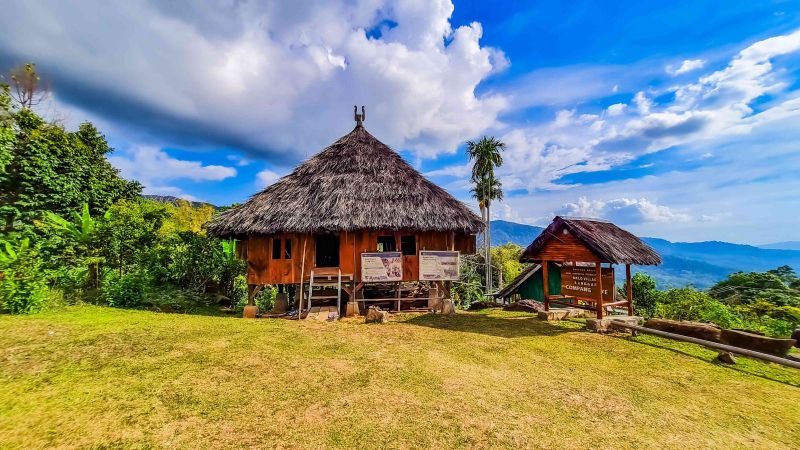
Flores Island in East Nusa Tenggara Province is a must-visit destination for travel enthusiasts due to its rich cultural heritage and ancestral history. One notable attraction not far from Labuan Bajo is the Compang To’e Melo Cultural Village, a traditional settlement located in Liang Ndara Village, Mbeliling District, West Manggarai Regency. This village offers a unique opportunity to explore the enduring cultural traditions and heritage of the Flores people.
Liang Ndara Village itself covers an area of approximately 618.5 hectares and sits at an altitude of 500 metres above sea level (ASL). It is divided into three hamlets: Melo, Mamis, and Cecer. The Melo Traditional Village, part of Liang Ndara, is situated around 24.8 kilometres from Labuan Bajo and can be reached within 45 minutes to an hour via the Trans Flores route. This accessible location makes the cultural village a popular destination for visitors seeking an authentic traditional experience amidst the splendour of Flores.
Perched at 624 metres ASL, the Compang To’e Melo Cultural Village boasts stunning natural views, with lush greenery, grasslands, rocks, and traditional Melo houses. The cool climate, ranging from 10 to 20 degrees Celsius, provides a comfortable atmosphere during the day, captivating visitors with the breathtaking landscape of the Flores highlands. The combination of natural beauty and rich cultural heritage offers an unforgettable experience for all who visit.
History
The name of the Compang To’e Melo Cultural Village originates from the word “Melo”, which in the Manggarai language means “to go first.” This meaning carries a philosophical significance related to journeys or precedence, likely connected to ancestral traditions or the migration history of the local tribe. Meanwhile, “To’e” refers to the indigenous tribe inhabiting Kampung Melo, affirming the ethnic identity and cultural heritage of the long-established community in the area. Thus, the village’s name serves not only as a geographical marker but also reflects the cultural values and historical legacy of the community that resides there.
Kampung Adat Melo is home to approximately 1,800 indigenous Manggarai people who have lived there for generations. The village is led by a traditional elder, known as the Tua Adat, who is selected through deliberation and collective decision-making during meetings and customary rituals, reflecting the community’s respect for shared values and traditions.
In truth, there is limited information available regarding the origins of the inhabitants of Kampung Adat Melo. This is due to the gradual decline in cultural and historical knowledge among the younger generation today. Furthermore, information obtained from the hosts or custodians of the Melo Traditional House during visits to the village is also quite limited. Nevertheless, the people living in Kampung Adat Melo are those who have resided there for generations within the same lineage. They have married, raised families, and some have relocated to neighbouring villages or even migrated beyond Flores Island itself.
Religion and Culture
1. Religion
Religious Rituals in Compang To’e Melo Village
Life in Compang To’e Melo Cultural Village is defined by a harmonious blend of two layers of belief: Roman Catholicism, which serves as the official faith of the majority of residents, and the animist traditions handed down from their ancestors. Although over 70% of the Flores population is Catholic, traces of animism remain deeply embedded in daily life, particularly in the rituals that accompany important events. The welcoming of guests—whether domestic travellers or international visitors—often begins with a traditional ceremony involving dance, traditional music, and symbolic offerings to ancestral spirits or protective deities. This coexistence creates a unique spiritual experience in which Catholic faith and ancestral traditions do not negate one another, but instead enrich the community’s cultural identity.
The Arrival of Roman Catholicism in Flores
The religious history of Flores cannot be separated from the arrival of the Portuguese in the eastern regions of the Lesser Sunda Islands in the 16th century. Catholic missionaries, particularly from the Dominican Order, established their work in areas such as Larantuka, which became the centre of Catholicism in eastern Flores. From there, Catholic influence gradually spread to other parts of the island through trade routes, intermarriage, and missionary activity. By the 19th and early 20th centuries, the spread of Catholicism into western Flores—including the Manggarai Barat region—had become more structured. Missionaries brought not only religious teaching but also education and healthcare, which served as a bridge to build trust and lasting relationships with local communities.
The Spread to Melo Village
Melo Village, now recognised as a cultural centre within Liang Ndara, began to receive Catholic influence through mission networks that reached the inland villages of Manggarai. This was not an overnight transformation; missionaries adapted their approach to respect and participate in existing local customs. This sensitivity allowed for a form of syncretism, where Catholic elements—such as harvest thanksgiving masses—were woven together with traditional practices like the Penti ceremony or the Caci whip dance. The result is a distinctive religious identity: the people of Melo remain steadfast in their Catholic faith while continuing to preserve animist customs as part of their ancestral heritage. In Melo, this balance between faith and tradition is not seen as a contradiction, but rather as a source of cultural strength that continues to shape the village’s character today.
2. Culture
Traditional House
Mbaru Gendang: The Traditional House and Guardian of Manggarai Cultural Identity
The traditional house in the Compang To’e Melo Cultural Village is known as Mbaru Gendang—a structure that serves not merely as a dwelling, but as the social, cultural, and spiritual heart of the Manggarai people. Traditionally, these houses are built using methods and designs passed down through generations, with little or no alteration to their original form and symbolic meaning. Although the Mbaru Gendang in Melo has undergone renovations to accommodate tourism, its principles, functions, and cultural values remain intact, standing as a living testament to the continuity of tradition.
The building is designed in the stilt-house style, with a thatched palm-fibre roof and wooden floors and walls. These natural materials are chosen not only for their availability but also for their symbolic significance. Palm fibre, known in the Manggarai language as wase wunut, represents strong bonds and community unity. The shape of the roof follows the lodok pattern—a traditional land division system resembling a spider’s web, symbolising harmony and order within the community. At the apex of the roof stands the rangga sekang, an ornament in the form of a horned human figure, signifying protection, courage, and spiritual strength.
The Mbaru Gendang’s structure is rich in symbolism. The central pillar, or siri bongkok, is both the main physical support of the house and a representation of the unity of the entire village. Beneath the roof lies a storage space for food reserves, reflecting the community’s wisdom in safeguarding food security. Inside, the Mbaru Gendang is the setting for numerous customary activities: from dispute resolution meetings (bantang gama reje leleng), to harvest thanksgiving ceremonies (penti), as well as rites marking birth, marriage, and death.
Beyond its ceremonial functions, the Mbaru Gendang is also a repository for tangible cultural heritage—housing gongs, drums, and equipment for the Caci Whip Dance, including buffalo horns, whips, and toda; as well as items for hosting guests, such as robo (palm wine), handwoven cloths, pillows, and mats made from woven pandan, which also serve as bedding for visitors staying overnight. In the context of cultural tourism, the Mbaru Gendang now plays an additional role as a reception space for guests and a meeting hall for planning the village’s tourism development. Yet, this interaction with visitors does not diminish its sacred function; rather, it provides an opportunity to share the village’s traditions and values with the wider world.
Ethnographic literature describes the Mbaru Gendang as an example of cosmological architecture. Its spatial arrangement reflects the Manggarai worldview: the upper level is dedicated to the spiritual realm and connections with the ancestors, the middle level to social life, and the lower space to storing agricultural produce—the community’s lifeblood. From the perspective of architectural anthropology, the Mbaru Gendang embodies the deep connection between people and their ancestral land, symbolising the intricate web of social relations, and serving as a medium for safeguarding tradition in the face of modernisation.
Traditional Dance
The Caci Dance is one of the most iconic war dances from Flores, which continues to be preserved in the Traditional Village of Melo. This dance is a symbolic duel between two male dancers who face each other, each wielding a whip (larik) and a shield (nggiling). The movements are not merely a display of strength but carry deep meanings of gratitude to ancestors, God Almighty, and respect for nature. This performance is typically held during the harvest festival (penti), moments of recovery from illness, or to welcome honoured guests and tourists.
The name “Caci” itself originates from the Manggarai language, where “Ca” means one and “Ci” also means one, thus it can be interpreted as “one against one.” The name is also connected to the chants that accompany the performance, where the dancers and musicians call out “caci, caci” in rhythm with traditional gong and drum music. More than just entertainment, Caci embodies three core values upheld by the Manggarai people: naring (to praise), hiang (to respect), and menkes (to rejoice). These principles guide the dance, emphasising that the contest is to be carried out with joy, respect for the opponent, and sincere gratitude.
In the past, Caci also functioned as a form of self-proving for men. The more whip marks a dancer bore, the higher his status and honour in the eyes of the adat elders and women of Manggarai. The dance became a symbol of maturity, where only men who had participated in Caci were considered grown and worthy of certain respect within the community. This tradition has deep historical roots, inspired by contests of skill among young men in inter-village rivalries passed down through generations.
The costumes and equipment used in the Caci dance are rich in cultural symbolism. The dancers wear panggal (headpieces shaped like buffalo horns) symbolising strength and courage, and the round shield nggiling, representing protection and the role of the mother. The whip larik is seen as embodying the role of the father and the sky, while the white trousers signify purity. The black ikat woven cloth worn by the dancers is adorned with distinctive Manggarai motifs that carry profound philosophical meanings — from social status and ethnic identity to ancestral stories conveyed through patterns and colours derived from natural dyes. This ikat cloth is an integral part of the performance, serving not only as attire but also as a representation of art and history.
Although Caci contains elements of physical confrontation, the philosophy underpinning it emphasises sportsmanship, peace, and mutual respect. Over time, Caci has ceased to be the sole determinant of male honour and has become a symbol of brotherhood and camaraderie. Today, it is mostly performed during traditional ceremonies, public festivals, visits by tourists, and even national celebrations.
One of the most fascinating aspects of the Caci dance is the atmosphere created during the performance. When the two dancers face off, their comrades dance around the arena, singing chants and shouting words of encouragement. The cheers from the audience add to the excitement, making the event not only a visual spectacle but a cultural experience that combines movement, music, singing, and the collective spirit of the Manggarai people.
Structure of Indigenous Communities and Social Life
1. Structure of Indigenous Communities
The social structure of Kampung Melo remains deeply rooted in the traditional customary law system, known locally as masyarakat hukum adat. This indigenous legal and social framework emphasises the governance and regulation of community life through established customary authority. Central to this system is the concept of ancestral lineage—residents of Kampung Melo trace their origins back to a single common ancestor, forming a kinship network that defines their identity and social organisation. This genealogical bond is a hallmark shared by many indigenous peoples across Indonesia, reflecting a continuity that predates the formation of modern nation-states.
According to both ancient and contemporary anthropological literature, customary law communities like those in Kampung Melo are structured around two fundamental principles: genealogical ties and territorial affiliation. Genealogical ties bind individuals through bloodlines descending from a founding ancestor, creating clans or lineages that hold social and ritual significance. Meanwhile, territorial ties link these kinship groups to specific land areas, reinforcing their collective rights and responsibilities to that land. This dual foundation ensures not only social cohesion but also the management of natural resources and cultural heritage within the community. Such structures have been studied extensively in indigenous societies worldwide, highlighting the importance of ancestral descent and land stewardship as pillars of customary law and community identity.
In Kampung Melo, this system endures as both a social and legal order, maintaining traditional values and governance despite external influences. The community’s adherence to these customary laws ensures the preservation of their cultural identity and strengthens their connection to their ancestors and their land.
The structure of the Melo Village traditional community is as follows:
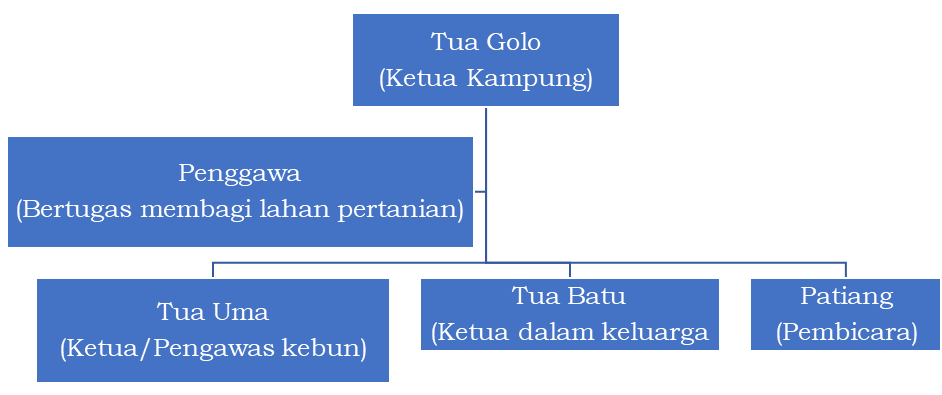
The social structure of the community in Kampung Adat Melo, based on the table above, can be explained as follows:
Tua Golo (Village Chief)
The highest position in this social structure is held by the Tua Golo, who serves as the village chief. The Tua Golo leads and manages all activities and the daily life of the community.
Penggawa (Land Distributor)
Beneath the Tua Golo is the Penggawa, who has the specific task of distributing agricultural land to the community members. The Penggawa is responsible for the management and allocation of farming resources.
Tua Uma (Head/Supervisor of the Gardens)
The Tua Uma acts as the head or supervisor of the gardens. The Tua Uma oversees and organises the agricultural activities within the village’s gardens.
Tua Batu (Head of the Family)
The Tua Batu is the leader within the family unit. They are responsible for managing and leading family affairs.
Patiang (Spokesperson)
The Patiang serves as the speaker or spokesperson. The Patiang’s role is to convey opinions or decisions during various village meetings and discussions.
In summary, this social structure clearly divides roles and responsibilities within the community, ranging from village leadership, agricultural management, garden supervision, family leadership, to spokesperson duties in community forums. This system demonstrates an organised division of labour that complements each other to sustain the community’s livelihood and well-being.
2. Social Life
Kampung Melo in Flores presents a vivid example of a community deeply rooted in traditional values that remain strong and enduring. Interactions among residents are characterised by warmth and a strong sense of togetherness. The spirit of mutual cooperation, or gotong royong, remains a central aspect of daily life, strengthening bonds of kinship and maintaining social harmony. Furthermore, religious tolerance flourishes, fostering a peaceful atmosphere where diverse faiths coexist with mutual respect. This pattern of social interaction not only reinforces communal ties but also reflects a cultural heritage passed down through generations in Kampung Melo.
The majority of Kampung Melo’s inhabitants rely on agriculture and farming as their main livelihood. They cultivate a variety of key crops such as vanilla, candlenut, clove, banana, and sweet potato. These agricultural activities serve not only as the primary source of income but also demonstrate a harmonious relationship between the community and their natural environment. This sustainable agrarian way of life echoes traditional farming systems found in tropical regions, which have adapted over centuries to the unique conditions of Flores. The success in cultivating these crops highlights the community’s ability to utilise natural resources wisely and effectively, while simultaneously preserving environmental balance.
In terms of education, Kampung Melo is well-equipped to provide learning opportunities from early childhood education (PAUD) through to senior secondary school (SMA). This reflects the community’s commitment to education as a means to improve the quality of life for younger generations. However, for higher education, most students must continue their studies in larger towns such as Kupang, Ende, Labuan Bajo or other major cities across Indonesia. This situation illustrates the educational dynamics in remote areas, where access to universities remains a challenge but also encourages a strong desire for learning and social mobility among the youth of Kampung Melo.
Transport facilities in Kampung Melo are sufficiently developed, facilitating residents’ mobility using both private and public means. Public transport options include bemo (minibuses), buses, and motorcycle taxis (ojek), which help connect the village with surrounding areas and nearby towns. Interestingly, locals refer to cars as “oto,” a term derived from the Dutch word “auto.” This linguistic legacy from the colonial era persists in everyday life and symbolises how external cultural influences have blended seamlessly with local traditions without eroding the community’s identity.
Overall, Kampung Melo exemplifies a harmonious blend of tradition and modernity within rural society. Social values such as mutual cooperation and tolerance, sustainable resource management, as well as attention to education and accessible transportation, demonstrate how the village maintains its cultural identity while adapting to contemporary developments. Kampung Melo is not merely a community that coexists socially and economically, but also a vibrant cultural space that continues to evolve, reflecting resilience and solidarity in the modern age.
Ecotourism Village
Melo Ecotourism Village developed as a cultural tourism destination following the encouragement of a tour guide who brought Dutch tourists from a Dutch travel agency to visit the traditional village several years ago. She was a woman who recognised the tourism potential of Melo Village. Acting on her suggestion, Melo Traditional Village began opening its doors to visitors and gradually evolved into a tourism village with support from Bank Indonesia, which showed a keen interest in its development. In 1993, the Manggarai District Tourism Office in East Nusa Tenggara officially designated Melo Traditional Village as an ecotourism village.
Melo Ecotourism Village offers a variety of distinctive cultural attractions for its visitors. Each arrival is welcomed with a unique ceremony, marked by the presentation of a shawl, which is draped by an Elder or the Elder’s assistant. Following this, guests are entertained with traditional dance performances. The local community boasts many types of dances, including the Caci Dance, Tuluk Cepa, Ako Mawo, Tetek Alu, Pacek Mawo (a dance representing rice planting), Ndundung Dake, and Sanda. However, not all these dances are performed at once. Only selected dances are showcased during the welcoming ceremony, with the Caci Dance being the most frequently performed and warmly received by visitors. The Caci Dance is particularly renowned for its harmonious and dynamic movements, offering an engaging and memorable experience for all who watch.
After enjoying the traditional dance performances, visitors are invited to enter the Adat House. Inside, an Elder conducts a ritual by reciting a prayer in the local language to seek permission from the ancestors to enter the house. This ritual also signifies that the visit is accepted by both the ancestors and the local community. Guests are then honoured with a serving of sopi (a traditional local drink) and a betel nut chewing ceremony, which is a form of respect and hospitality extended to visitors of Melo Village. This tradition of sharing sopi and betel nut is not only practiced in Melo Tourism Village but is also common throughout the island of Flores and the wider East Nusa Tenggara province. This age-old custom symbolizes camaraderie and continues to be upheld to this day.
At Melo Village, visitors can engage in a variety of activities. After participating in the ceremonial events and enjoying a communal lunch, guests have free time to explore the village at their leisure. Those wishing to capture unique memories can dress in traditional Manggarai Barat attire and take photographs. Photography enthusiasts will find every corner of the village to be a beautiful subject to capture. Interacting with local residents and taking leisurely walks around the village offer opportunities to learn more about the daily life and culture of the Melo community.
Similar to other tourist destinations, Melo Tourism Village also produces a range of handicrafts that are sold to support the local economy and promote the growth of the ecotourism village. The crafts available include traditional woven textiles such as sarongs, shawls, customary blankets, traditional hats, bracelets, bags, and more. In addition, local agricultural products such as vanilla and coffee are also offered for sale.
The Compang To’e Melo Cultural Village also provides accommodation within the Adat House itself for visitors who wish to stay overnight. Inside the house, there are traditional mats and pillows made from woven mats. Although simple in appearance, these mats and pillows are surprisingly comfortable to rest on. The accommodation is not private but rather a shared, open-plan room, offering guests a unique and authentic lodging experience.
Besides the Compang To’e Melo Cultural Village, the Liang Ndara Tourism Village offers several other ecotourism potentials and attractions, such as:
-
Mount Mbeliling – Here, visitors can enjoy trekking, birdwatching, observing Flores’ unique flora, camping, and witnessing stunning sunrises and sunsets.
-
Liang Kantor and Cunca Rami Waterfalls – These waterfalls are located not far from Melo Tourism Village. Visitors can swim and relax while enjoying the natural surroundings.
-
Melo Peak – This is a cultural tourism spot where visitors can appreciate the natural scenery, watch the sunset, savour local cuisine, enjoy traditional dance performances, and even learn weaving and basketry.
-
Liang Niki Cave – Tourists can go trekking and observe the activities of bats in their natural habitat.
-
Local Culture – This offers an authentic insight into the daily lives of the villagers. Visitors can learn how to make sopi (a traditional local drink) and experience traditional rice field ploughing.
Although Liang Ndara Village (home to the Compang To’e Melo Cultural Village) is small, it provides a memorable tourism experience that leaves a lasting impression on its visitors.
Important Information for Visitors to Compang To’e Melo Cultural Village
-
It is important to note that visitors to Melo Tourism Village are not always greeted with traditional dances, ritual ceremonies, or received personally by an Elder, as some sources on the internet might suggest. This can sometimes lead to disappointment among visitors with limited information. The welcoming ceremony and dance performances are only held if visitors book a full package through a travel agent, as these attractions and rituals require preparation well in advance.
-
Visitors planning to stay overnight at Compang To’e Melo Cultural Village are advised to bring warm clothing, as the village is located at a high altitude where temperatures can be quite cool.
-
While the culture and local wisdom presented at Melo Tourism Village remain authentic, some comments suggest that this may not satisfy those seeking a fully immersive local experience. It should be understood that Compang To’e Melo Cultural Village was primarily developed as a cultural tourism destination. For those wishing to experience genuine traditional lifestyle and local wisdom, this village may not be the ideal choice.
-
Visiting Compang To’e Melo Cultural Village is not free of charge. Many travel agencies offer full packages for visits to Melo Village, with prices varying depending on the package selected.
-
Entrance fee: IDR 100,000 per person
-
Traditional costume photo session: IDR 100,000 per person
-
Accommodation: varies
-
Voluntary donations: not specified
-
-
The shawl presented to guests is a symbol of respect and acceptance. After the rituals and visit are complete, the shawl must be returned.
-
Visitors may politely decline to drink alcoholic beverages such as sopi or to chew betel nut if they do not wish to do so. This will not diminish the respect shown by the local community.
Conclusion
The story of Liang Ndara Village, home to the Compang To’e Melo Cultural Village, is deeply rooted in a rich tapestry of history, culture, religion, and social life that has shaped its identity over generations. This village, with its origins as a traditional settlement, has embraced ecotourism as a means to share its unique heritage with the world while striving to preserve the sacred values handed down by its ancestors. The rituals performed by the Tua Adat, the traditional dances like the renowned Caci, and the communal ceremonies such as the sopi and betel nut gatherings, all reflect a profound connection between the people, their land, and their spiritual beliefs.
As an ecotourism village, Liang Ndara offers more than just scenic beauty and cultural performances; it embodies a living tradition that invites visitors to engage with the genuine rhythms of local life—whether through participating in age-old rituals, exploring the natural wonders like Mount Mbeliling and the nearby waterfalls, or learning traditional crafts such as weaving and basketry. However, this delicate balance between tourism and tradition requires thoughtful stewardship. The village’s development into a tourist destination should never overshadow its core purpose: to serve as a vessel for cultural preservation, spiritual respect, and community well-being.
It is essential that visitors approach Liang Ndara not merely as spectators seeking entertainment but as respectful guests eager to understand the deeper narratives of a people whose identity is inseparable from their land and customs. To achieve this, there must be clearer, more comprehensive communication about the village’s history, values, and the meaning behind its customs, so that every visit transcends the superficial and becomes a meaningful exchange of knowledge and respect.
Ultimately, the success of Liang Ndara Village as an ecotourism destination is a testament to the resilience and generosity of its people. The high-quality presentations, authentic cultural experiences, and, above all, the warm hospitality extended by the local community, leave a lasting impression on all who come. This village stands not only as a beacon of cultural pride for the Manggarai people but also as a reminder that true tourism flourishes when it honours the spirit of the place and its people, fostering understanding, connection, and mutual respect.
Note:
Prices are subject to change depending on prevailing regulations.
Written by BK
Agustus 2025
Copyright Full Moon Tour & Travel